

I am back from the break (which I may or may not write about another time), and excited to reconnect with you. Thank you for your patience!
It is November, which means we are constantly bombarded with new emails, deals, gift guides and sale picks. It can all become a bit frenzied and overwhelming. I wanted to share a good method I recently discovered to prioritize what to spend your money on, without getting lost in the deal-on-deal frenzy.
This method is not ideal when there is a sharp change in seasons or drastic lifestyle changes, but in all other situations, it works really well.
Step 1. Identify your most-worn items
There are many ways to do this. You can take an outfit picture every day and feed it to AI, use Stylebook or Indyx, or go with an analogue method and move the hangers of the pieces you wear most often to one side of your wardrobe. You can also simply wing it and estimate which items are your most worn.
Once you have a list of your top items, move on to the next step.
Step 2. Score how much you like the pieces you wear most
Now, this may seem surprising, as theoretically you wear the pieces you like the most. In my experience, that’s not necessarily the case. They might not fit your lifestyle (say, you love your dresses but mostly wear sweatpants), or you might simply have only one pair of winter shoes. You may also be bored with the pieces you wear every day, even if they are perfectly functional.
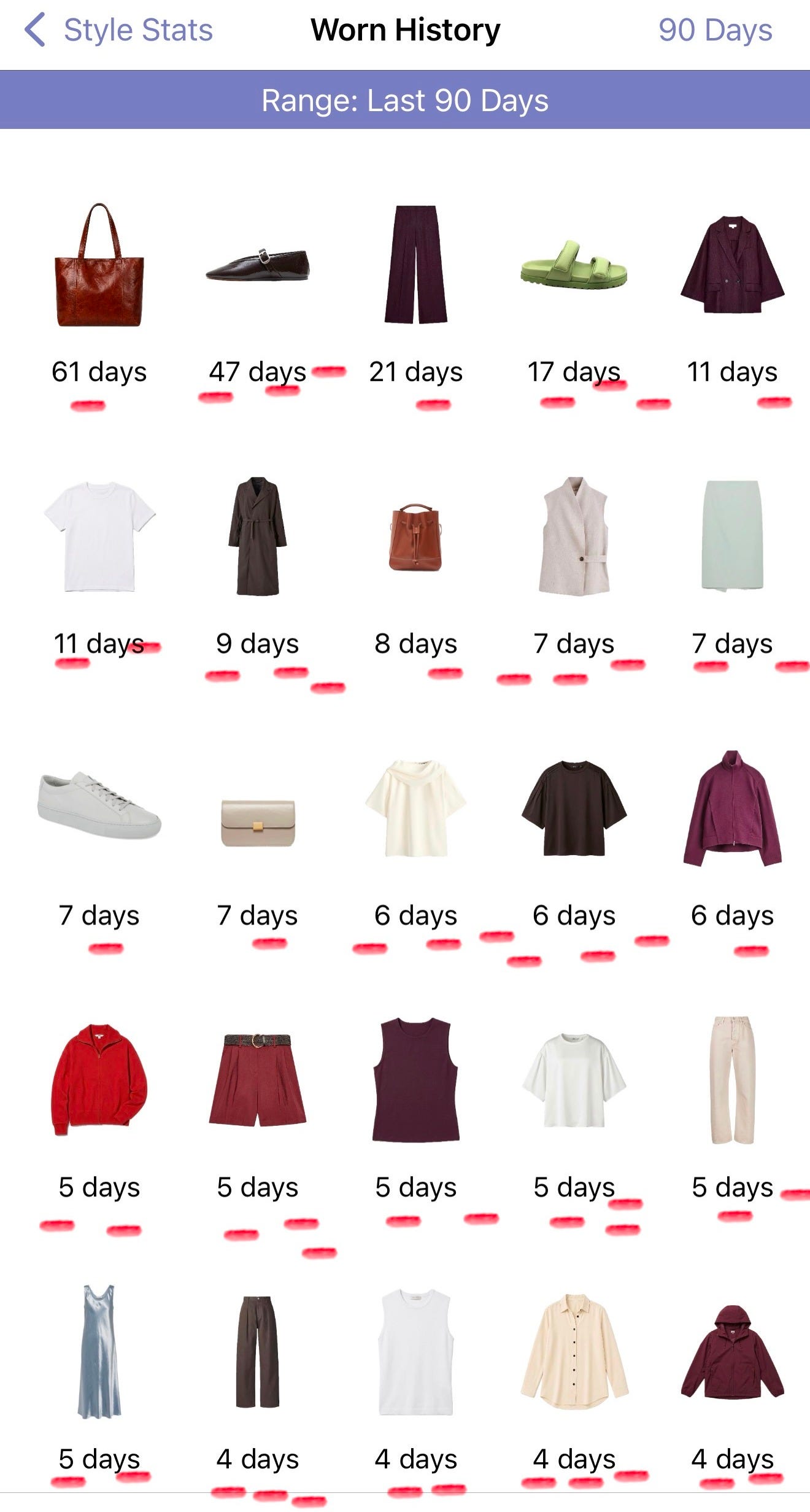
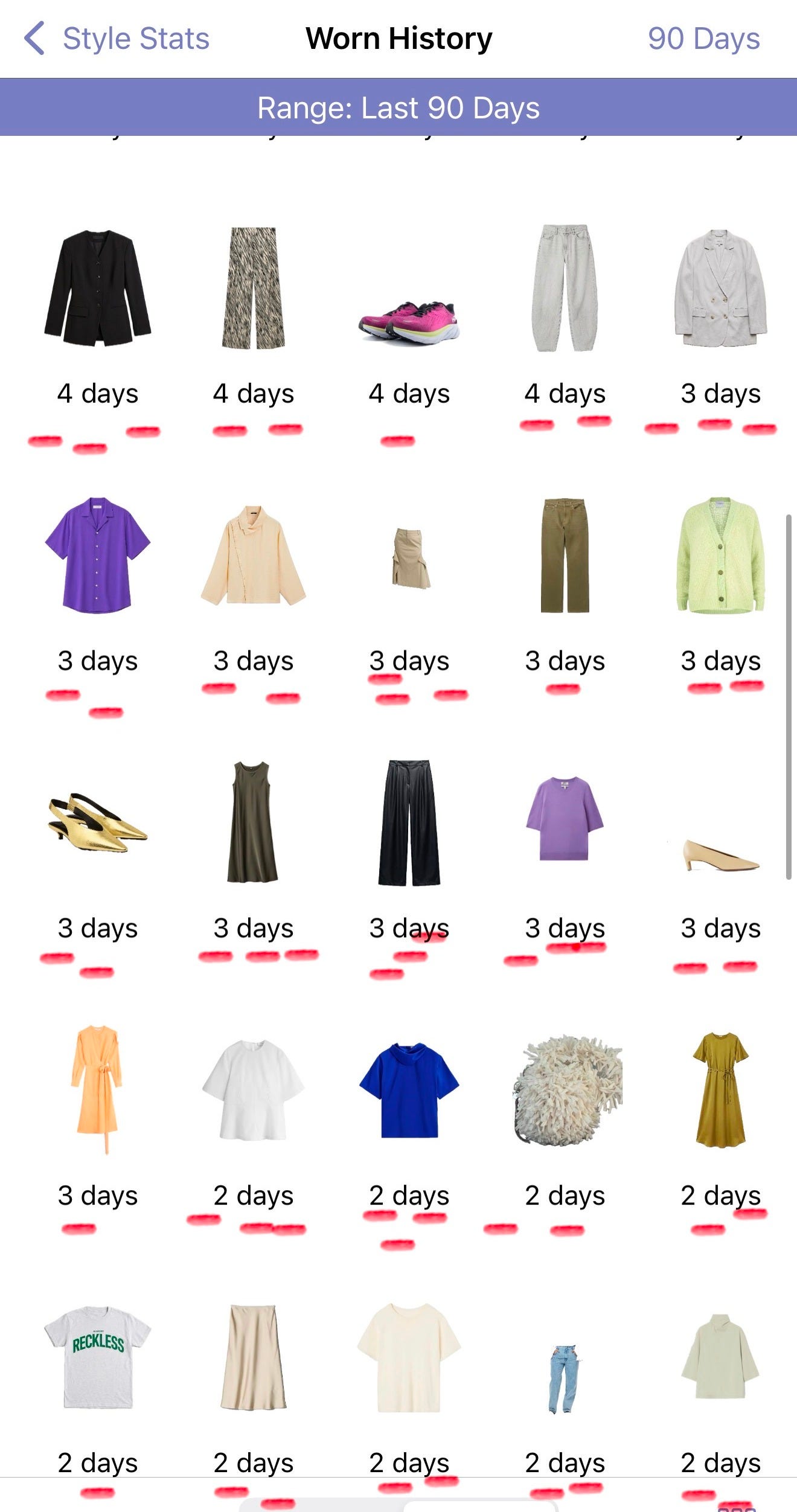
I personally track my outfits more or less consistently in Stylebook, so I have a good overview of my most-worn items. I took a screenshot and added one dash for pieces I felt meh about, two dashes for “it’s okay” pieces, and three dashes for pieces I truly love.
Then I fed these screenshots to AI and asked it to identify patterns, but frankly, it’s perfectly possible to do this yourself.
3. Replace the most-worn pieces you dislike
If an item is among your most-worn pieces, it means it fulfils a function and is genuinely useful in your life. However, if you dislike it, it means you’re dealing with that annoyance on a daily basis, and it’s stealing some of the joy from getting dressed.
In my case, I wore the bag I bought in Morocco almost every day. Over time, it started losing its shape, and I stopped liking it as much. Still, it was the only bag that could carry my laptop, and I loved how spacious it was for all my daily essentials. So, somewhat reluctantly, I kept wearing it. I also don’t particularly like any of the other bags I wear frequently, as they are quite worn out by now. As a result, a new bag is currently at the top of my priority list.
Another example is my eggplant-coloured Zara suit. I love the colour and how lightweight the suit is. However, the material quality is quite “Zara”, and as a result, it brings me less joy than it otherwise would. At the same time, it’s a lightweight, relaxed suit that isn’t too formal, which I love and find very useful in my daily life.
You can also approach this from a functional perspective. You don’t necessarily need to replace a lightweight pair of trousers with another pair of lightweight trousers. Maybe culottes or a relaxed skirt could fulfill the same function. So feel free to interpret the results more freely and draw your own conclusions.
If you feed this data to AI, you can also uncover other patterns. For example, you might discover that you love the dresses in your wardrobe but rarely wear them, that you’re oversaturated with tops you love but barely reach for, or that you tend to wear dark clothes most of the time.
Overall, I think it’s a great tool for ruthless prioritization. And I believe ruthless prioritization is absolutely essential amid all the noise of the fashion industry, especially in November.
That’s it for this method. Let me know what you think!